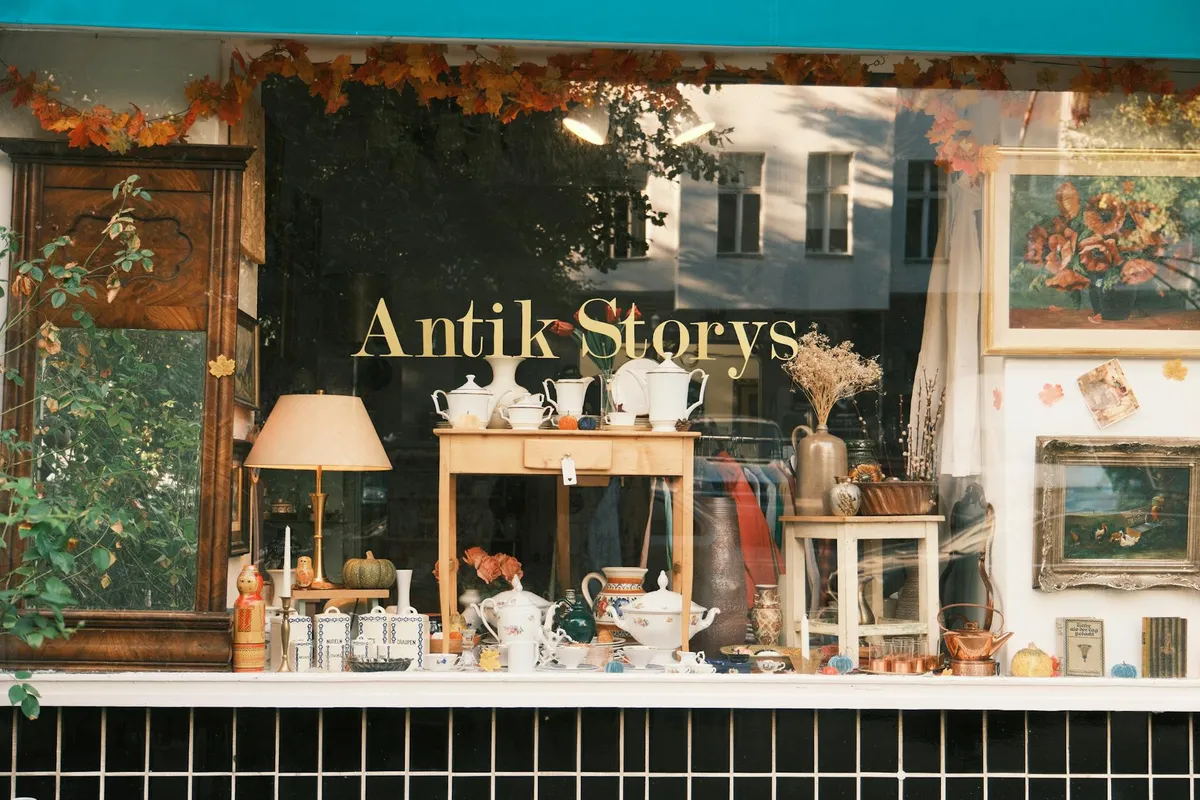
There is a consignment shop on Warren Street, approximately four blocks from my apartment, that I have been going into for almost five years. The shop occupies the ground floor of an old building that was originally something else — possibly a bank, possibly a small department store, the exact history is one of those things the woman who runs the shop has told me several times and that I keep almost remembering. The interior is two long rooms with high ceilings, warm wood floors, and a constantly rotating inventory of secondhand furniture, lamps, dishware, small framed prints, and the occasional book.
The woman who runs the shop is named Dee. She is, by my best estimate, somewhere in her late fifties. She has been running the shop for about twelve years, which means she had been there for seven years before I moved to town. She is the kind of small-town shopkeeper who would have been a beloved character in a novel about a small town, except that the novel would not capture her properly because she is not a character, she is a person, and the difference between a beloved-shopkeeper character and an actual beloved shopkeeper is the difference between a sketch and a portrait.
How the relationship started
I went into the shop the first week I lived here. I was furnishing the apartment from approximately zero. I had moved from a city apartment that I had been sharing with a partner, and the breakup had been recent enough that I did not have furniture of my own — most of what I had taken was books and clothes and a small number of kitchen things. I was looking for a chair, a small table, a lamp, and whatever else might catch my eye.
Dee was at the front counter. She asked what I was looking for. I told her, in more detail than I had meant to, that I had just moved up from the city and was furnishing an empty apartment and was trying not to spend a lot. She asked what kind of apartment. I told her — second floor, two rooms and a kitchen, tin ceiling, southwest-facing window in the kitchen. She nodded. She walked me through the shop and showed me three pieces — a small kitchen table, a wooden chair, and a brass floor lamp — and said that these were the ones that would suit the apartment I had described.
I bought all three. The total was less than two hundred dollars. They are still in the apartment. The lamp is currently lit, behind me, as I write this. The chair is at the kitchen table. The small kitchen table is the same one I have already mentioned in another entry. Five years later, the furniture Dee picked out for me on my second day in town is the furniture I am still living with.
What the visits look like
I go into the shop about once a month, give or take. I do not always buy something. Some visits I just walk through and look at what has changed since the last time. Some visits I find something — a small framed print that came in from an estate sale, a piece of ceramic that someone had brought in the week before, a book that had been overlooked in the back room. The visits are short, usually fifteen or twenty minutes, sometimes longer if Dee and I get to talking.
The conversations have, over five years, accumulated a great deal of information about Dee's life that I would not have known to ask for. I know her daughter lives in Portland and her son lives nearby. I know the building used to be owned by a man named Howard whose family had owned it since the 1920s. I know the slow-moving inventory category in the shop is dining tables, which she has too many of and cannot move at the asking prices, and that this has been a low-grade frustration of hers for the entire time I have known her. I know her opinions about three of the other shopkeepers on Warren Street, two favorable and one tartly unfavorable.
She knows, in turn, a substantial amount about me. She knows what the apartment looks like. She knows about my job at the library. She knows that I rotate between three dinners. She knows that I am from a town in central Massachusetts and that my parents still live there. She knows that I am not currently dating anyone and has not pressed on the subject in a way that I am grateful for.
The category of friendship this is not
Dee and I have never had each other over. We have never gotten coffee outside the context of the shop. We do not have each other's phone numbers. We are not, by any meaningful definition, friends in the sense that I would use the word about someone I might call to talk about a bad week.
And yet. The relationship has the rhythm and the accumulated knowledge of something that is not nothing. We have known each other for five years. We have had probably sixty conversations of moderate substance. We have been present for some of the contours of each other's lives — she was there the week my apartment was being furnished, I was there the week her dog was put to sleep two years ago and she was visibly sad behind the counter — and the small recurring presence has produced a kind of relationship that I am not sure the standard vocabulary covers.
I think this is a category of relationship that small-town life produces more frequently than city life. In the city I had friends and acquaintances and coworkers, and these were largely distinct categories, and the people who ran the shops I bought things from were people I saw once. Here the shopkeeper is also a fixture of my week. Dee is, in some functional sense, more present in my life than several people I would more readily call friends.
The piece I bought last month
Last month I bought a small wooden side table from Dee. It is the kind of side table that holds a lamp and a book, no more. It is approximately a hundred years old. The wood is dark and the joinery is good and one of the legs has a small repair I did not notice until I had brought it home. The repair is the kind of small wooden patch that someone made carefully a long time ago and that has held up since. I am, somehow, fonder of the table because of the patch than I would have been if the table had been perfect.
Dee told me, when she sold it to me, that it had come in from an estate sale in Catskill the previous week. The estate was the estate of a woman who had been a teacher for forty years and who had lived in the same small house her entire adult life. The table had probably been in that house for decades. Dee was pleased that I was taking it because she thought I would treat it well.
I treated her assessment as a serious one. The table is now in the corner of the bedroom, holding a small lamp and the book I am currently reading. I think about the teacher in Catskill sometimes when I put the book down at night.
What the shop has become
The shop has, over five years, become more than a shop in my life. It is the place where the furniture I sit in came from. It is a place where I go to slow down on a Saturday afternoon. It is the place where I have a fifteen-minute conversation with a person I have come to like very much and who I do not have any other context for liking. It is, in some way that I would have a hard time defending in front of an economist, a part of the infrastructure of my contentment in this town.
I will go in again next month, or the month after. Dee will be at the counter. We will say hello and she will tell me what has come in. I might buy something. I might not. The visit will end with both of us slightly better off for having seen each other, in the small and undramatic way that the best of these small-town relationships work. It is enough. It has been enough for five years. I think it is going to keep being enough for as long as we are both still here, which I hope is a long time.