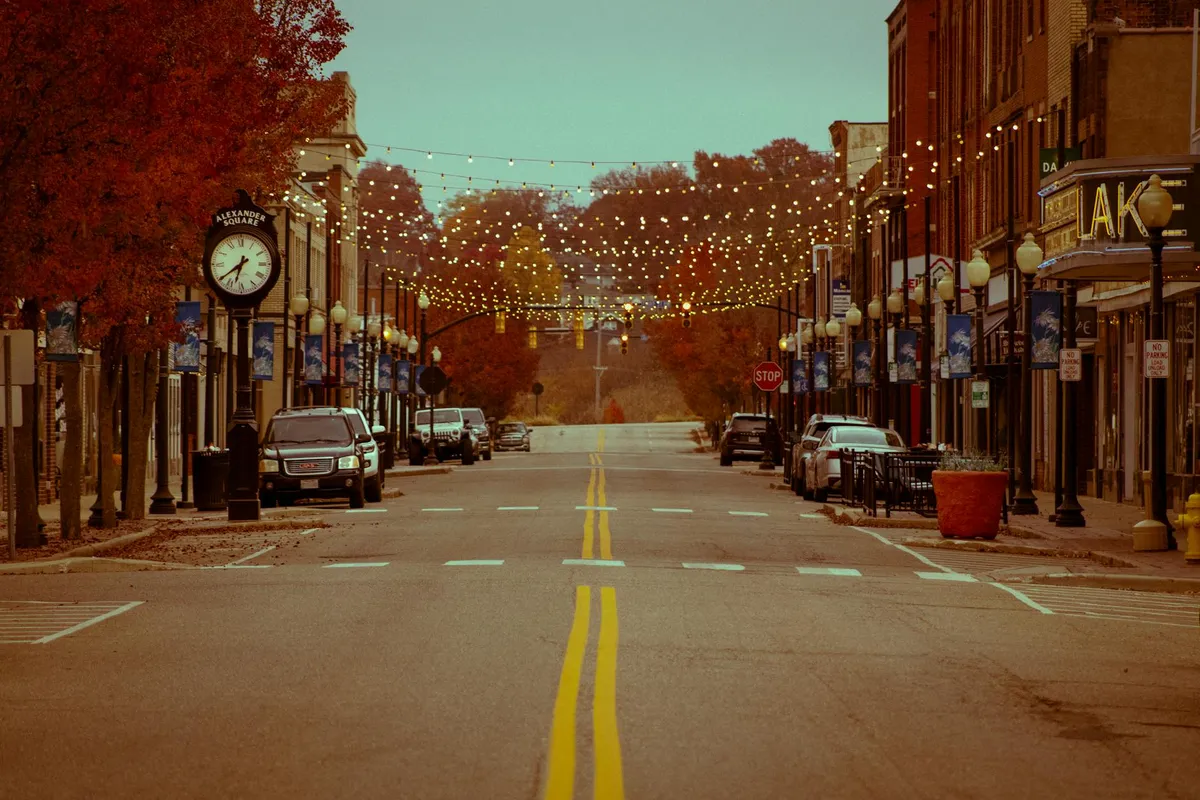
There is a walk I take from my apartment that goes north on the main street, east on the third side street, north again on the river road, east through the small park that runs along the water, south on the road behind the train tracks, west through the residential blocks behind the library, and finally south on the main street back to my front door. The walk takes approximately fifty-five to sixty-five minutes depending on weather and pace. It does not go anywhere. There is no destination at any point in the loop. I have started to think of it as the most consistently useful thing I do in my entire week.
I take this walk when I am stuck on something. When I am anxious about something and cannot put my finger on what. When I have spent too much of the day at the apartment and need to readjust the boundaries of my body in space. When a conversation has gone badly and I need to think about why. When a piece of writing has stalled and I do not know what to do next. The walk does not solve any of these things directly. The walk is structurally unrelated to any of them. The walk does, however, change something — and I have come to rely on the change without entirely understanding it.
What the walk physically involves
The walk is not strenuous. The terrain is flat. The pace is a comfortable normal walking pace, perhaps slightly faster than I would walk if I were doing errands. The total distance is somewhere around three miles, give or take depending on whether I take some of the optional small detours that the route allows for.
I do not listen to anything while I walk. No music, no podcasts, no phone calls. I do not take my phone out of my pocket. The walk is, structurally, a kind of sensory blank, where what is available to me is only the immediate environment and whatever is happening inside my head. The environment is moderate. The town is moderately quiet. The river is moderately interesting. The residential blocks are moderately handsome. Nothing about the route is dramatic. It is, by design, the kind of route where nothing will demand my attention.
What this means in practice is that the walk leaves my head almost completely alone. The first ten minutes my head is usually still chattering — the thing I am stuck on, the thing I am anxious about, the email I should have sent, the conversation I am replaying. By twenty minutes the chatter has slowed. By thirty minutes I am usually noticing the trees. By forty minutes the original thing has either resolved itself or moved into a different and less acute configuration. By the time I get home the matter is not solved but it is differently shaped.
What I think is happening
I do not have a scientific theory of what is happening on the walk. I have a layperson's impression, which I am offering here only as an impression. I think the walking activates a part of the brain that processes things in the background, and that the walking removes me from the situations and devices that are keeping the foreground brain hyperactivated, and that the combination of these two things produces a slow background sorting that the foreground would not otherwise have permission to do.
I have read a small amount of the research literature on this and the research seems to support some version of this impression, but I would not want to overstate my reading of it. What I can say with confidence is that I have taken this walk hundreds of times over the years I have lived here and the pattern of relief — partial, inconsistent, but real — is robust enough that I trust it more than I trust most other interventions I have available.
The two specific stuck moments the walk has solved
I want to be specific about what the walk has done because the abstraction does not do it justice. Two examples.
About two years ago I was trying to decide whether to take a different job at a different library in a different town. The offer was sitting on the table for several weeks. I went back and forth on it. I made spreadsheets. I talked to friends. I lost sleep. None of it was producing a clear answer. One afternoon I took the loop and somewhere around the river road section the answer was suddenly available — I did not want the other job and I did not want the other town and the question had stopped being a question. The walk did not produce a new piece of information. It produced a clearing in which the existing information could resolve.
About six months ago I had a small but persistent disagreement with a person I am close to that I could not figure out how to address. The disagreement had been going on for weeks and I had been rehearsing different conversations in my head and none of them felt right. I took the loop and somewhere around the park section I realized that the entire problem was that I had been preparing to defend a position I did not actually hold. The position I actually held was different and more honest and would not produce the kind of confrontation I had been bracing for. The conversation, when I had it the next day, was structurally different from the conversation I had been preparing for. It went well.
The walks that did not produce anything
It is also worth being honest that the walk does not always produce anything. There have been plenty of times I have taken the loop with something on my mind and arrived home with the same thing on my mind, no better and no worse than when I started. The walk is not magic. The walk is a moderately reliable intervention that fails some percentage of the time.
What I have come to think is that the walks that do not produce anything are not wasted. The walking still happened. The hour outside the apartment still happened. The body was still moved. The brain was still given a small enforced break from whatever it had been chewing on. The intervention may have failed to produce a resolution but the underlying activity is still good for me on the days when it does not. I have stopped expecting any individual walk to deliver. I have come to rely on the walk as a long-term practice rather than as a same-day fix.
What the walk has done to my sense of the town
The walk has also, over the years, produced a kind of map of the town in my head that I would not otherwise have. I know what the river looks like in every season. I know which trees turn color first. I know where the cracks in the sidewalk are. I know which houses have new paint and which have not been painted in many years. I know which dogs are friendly and which are aloof. I know where the wind comes from in winter.
None of this knowledge has any practical use. All of it has, in some quiet way, made the town more mine. I cannot imagine living somewhere and not having a route. I cannot imagine not knowing the cracks in the sidewalk. The walk has converted a town I moved to into a town I live in, and the conversion has been slow and accumulative and has happened mostly during hours in which I was, ostensibly, trying to figure out something else.
I am going to take the loop today. The afternoon is mild. There is nothing in particular I am stuck on, but I have not done it in a few days and I miss it. I will not bring my phone. I will not listen to anything. I will get home in approximately an hour and the day will be slightly differently shaped than it was when I left. The walk is, in my actually-lived experience, one of the most useful things I do, and the cost of doing it is nothing more than the hour itself.