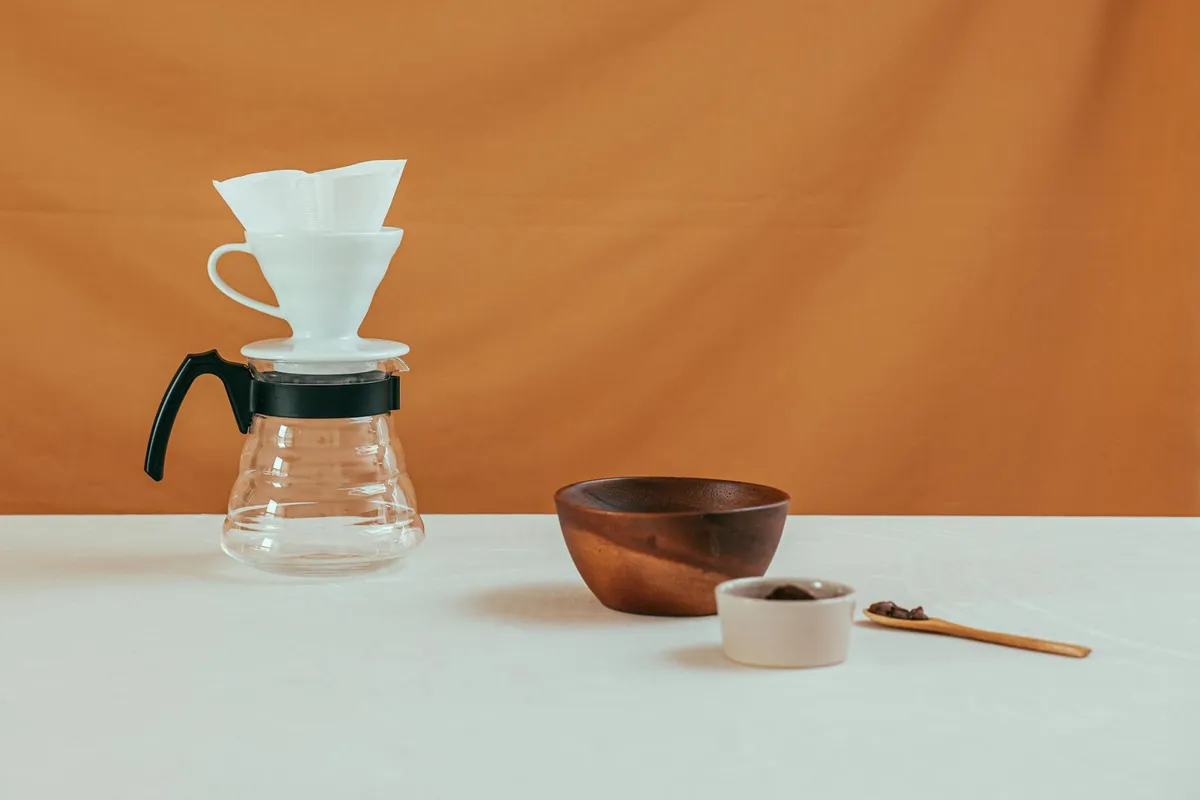
I make my coffee in the morning with a small ceramic dripper that I have owned for nine years. The dripper sits over a glass carafe. I grind the beans by hand in a small burr grinder that takes about ninety seconds to produce enough for two cups. I heat the water in a gooseneck kettle. I wet the filter. I pour the water over the grounds in slow concentric circles, starting from the center and moving outward, in approximately four pours of approximately equal volume. The whole process takes about four minutes.
I have been making coffee this way for nine years. I am writing about it here because I have recently come to think that the four minutes are doing more work than I had previously credited them with. They are not, as I would have said earlier, simply a way of making coffee. They are the first real decision of the day — the first thing I do that requires my actual attention — and the day proceeds differently depending on whether I have done it properly.
What the four minutes actually contain
The four minutes contain a sequence of small physical actions, each of which has a particular sensory texture. The grind, in the burr grinder, makes a specific shifting-gritty sound that I associate so strongly with morning that I would have a hard time hearing it at any other time of day without feeling momentarily disoriented. The smell of fresh-ground beans is a smell I have not in nine years gotten tired of. The hiss of the kettle reaching temperature. The first pour onto the bloom, when the grounds rise and expand and release a small dome of carbon dioxide. The slow circular motion of the subsequent pours.
None of this is dramatic. None of it is interesting to describe. It is sensory wallpaper, in a sense — the kind of background information that does not normally rise to the level of conscious notice. What I have started to think is that this is precisely the value of it. The four minutes are the part of the day when nothing is asking me to think and the senses are simply receiving what is in front of them. The decision-making part of the brain, which by mid-morning will be running constantly, is still in the warm-up phase. The senses are doing the work.
What the four minutes are not
I want to be careful to distinguish what I am describing from the kind of morning ritual that has become a wellness commodity. I am not making the coffee slowly because I am being mindful at the coffee. I am not setting an intention. I am not breathing into the experience. I am simply making coffee, with reasonable care, in a way that I have practiced enough that my hands know what they are doing.
The distinction matters. The wellness version of slow coffee is a performance of slowness on top of a practical activity. The version I am describing is just the practical activity, done at the speed it takes to do it well. The slowness is incidental to the carefulness. The carefulness is the point.
I do not feel virtuous after the pour. I do not feel that I have meditated. I feel that I have coffee. The coffee is good. The four minutes have prepared me, in some quiet and not particularly articulable way, to be available for the next thing.
What happens when I skip it
I sometimes skip the pour. I make coffee with a French press, which takes less effort and produces a cup that is also good, or I drink tea, or I am running late and I leave the apartment without coffee and pick something up on the way to the library. On those days the morning has a different shape.
The different shape is hard to describe. It is not as though I am noticeably worse at my job or noticeably less patient with the people I encounter. The difference is internal. The first hour of the day feels, on the skipped-pour mornings, slightly less located. I have the sense, mildly, that the day has started without me — that I am playing catch-up with something that the pour would normally have placed me firmly inside of.
I have stopped skipping it as often as I used to. The improvement is not dramatic enough that I would urge anyone else to take up the practice. It is just enough that I have come to defend the four minutes against the small daily temptation to be more efficient.
The objects involved
The dripper is white ceramic. The carafe is plain glass. The kettle was a gift from my sister for a birthday eight or nine years ago. The grinder is a hand-cranked thing in matte black plastic that I bought when I had just moved into a different apartment in a different city and was beginning, at the time, to take coffee more seriously than I had previously.
None of these objects is expensive. The full setup probably cost less than two hundred dollars to assemble and most of that was the kettle. They have all held up well. They are now, after nine years, slightly worn in the way that objects you use every day become slightly worn — the carafe has a faint chip on the lip, the dripper has fine cracks in the glaze, the kettle has a small dent from when I dropped it once. The wear is part of why I like them.
I am genuinely fond of these objects in a way I would have been mildly embarrassed by in my twenties, when I would have said that being fond of objects was a sign of materialism or sentimentality. I do not think it is either of those things. I think it is the natural development of a relationship with a thing you use every day with some care over a long period. The objects have done me a kind of work, and the wear is the trace of that work, and the fondness is the appropriate response.
Why the first real decision matters
The reason I have come to think of the pour as the first real decision of the day is that everything before it is automatic. I get out of bed. I use the bathroom. I put water on. I open the curtains. None of this requires anything from me. The pour, by contrast, is the first activity that requires that I pay attention to what I am doing. The angle of the pour matters. The rate of the water matters. The amount of bloom time matters.
It is a very low-stakes decision-making situation. The worst that can happen is that the coffee is slightly under-extracted. The best that can happen is that the coffee is exactly right. The range is narrow and the stakes are minor. But the activity is structurally the same shape as the larger decisions I will face later in the day — attention, small adjustments based on feedback, the application of practiced judgment to a specific situation.
The four minutes are, in this sense, a kind of warm-up scrimmage for the day. They put the attention-paying part of me into motion at low stakes before the higher-stakes deployments are required. I had not noticed this for the first several years I was making coffee this way. I have started to notice it recently, and I am noticing it more often. The pour is the small daily exercise that quietly readies the rest of the equipment. I have come to be grateful for it in a way that I cannot quite explain without sounding more grand than I want to sound about a cup of coffee in a small kitchen on a Tuesday in February.