A small bakery opened on Warren Street about eighteen months ago, in a storefront that had been a leather goods store and before that a barbershop and before that probably any number of other things. The bakery is run by a woman and a man, who I believe are partners both personally and professionally, and who I am not yet on a first-name basis with despite buying bread from them roughly every week. The shop has six tables, a small counter, a display case of pastries that change daily, and a back room where the actual bread baking happens.
They make a different bread each day. Mondays they are closed. Tuesdays they do a pain de mie that is reliably good but not the kind of bread you go out of your way for. Thursdays and Fridays are sourdough variants. Saturdays they do a baguette program that has a small line outside the door from about nine in the morning. Sundays they do whatever they feel like, which has variously been a rye, a focaccia, a country loaf with seeds, and once a brioche that sold out by ten in the morning.
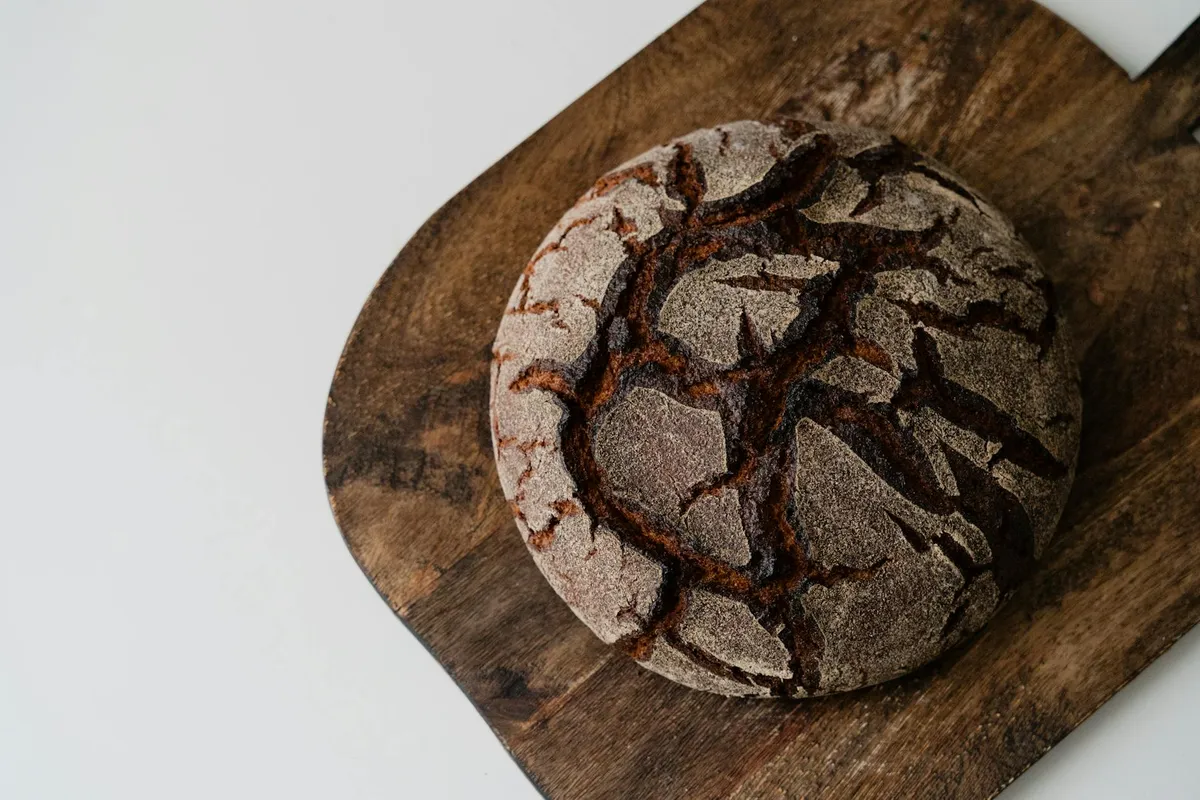
Wednesdays, they do a single specific loaf. The loaf is a long sourdough with olives in it. The crust is dark, almost approaching burned. The crumb is open and chewy. The olives are good olives, not the sliced canned variety. The salt is right. The loaf, when it is fresh out of the oven, is one of the small reliable pleasures of my life.
The schedule I have built around it
I have, over the past several months, begun structuring my Wednesday around the loaf. I work at the library on Wednesdays from one to seven. I walk to the bakery in the late morning, usually around ten thirty, when the bread has been out of the oven for approximately an hour. I buy one loaf. I walk it home. I eat a slice of it, with butter, at the kitchen table, sitting in the chair I bought from Dee five years ago, looking out at the street that the man with the dog walks past at 7:42 on the mornings I am paying attention to it.
The whole thing — the walk to the bakery, the purchase, the walk home, the slice with butter — takes about thirty-five minutes. It is the most concentrated single piece of pleasure I have scheduled into any of my weekdays. I do not have a similarly structured pleasure on Monday, Tuesday, Thursday, or Friday. Wednesday has the bread.
I have started, over the past several weeks, looking forward to Wednesday in a way that I did not used to look forward to it. Wednesday used to be a slightly difficult day — it is the middle of the week, my shift at the library is the longest of my shifts, and there is no clear weekly anchor on it. The bread has become the anchor. The bread has converted Wednesday from a day I had to get through into a day I have something specific to wait for. The conversion is not trivial.
What the loaf actually costs
The loaf costs nine dollars. This is more than a loaf of bread used to cost when I was a younger person and more than a loaf of bread costs at the grocery store. I am aware that I could spend less on bread. I am not aware that there is a better return on a single weekly nine-dollar expenditure available to me in any other category of small-pleasure spending.
I have run the math on this informally. A weekly nine dollars is approximately four hundred and sixty-eight dollars a year. The loaf produces, by my count, approximately twelve substantial slices, which lasts me through to Saturday or Sunday at a rate of roughly two slices a day, eaten variously with butter, with cheese, dipped in soup, or as the foundation of toast. The cost per slice is approximately seventy-five cents.
The grocery store bread I would otherwise buy is about four dollars a loaf and produces roughly the same number of slices at a cost per slice of about thirty cents. The Wednesday loaf is about two and a half times the cost per slice of the grocery store bread. The Wednesday loaf is also, on the metric of how much pleasure I take in eating it, easily five or six times the grocery store bread. The ratio is favorable. I am going to keep buying it.
The argument against the cheaper version
I have, several times, thought about whether I should be buying the more expensive loaf at all. There is a version of me — the version that was younger, that was paying closer attention to small expenditures, that believed in the moral importance of not spending money on things you could get cheaper — that would have looked at the nine-dollar loaf with skepticism.
I have, in middle age, become less convinced by that version of myself. The argument against the cheaper version is that the cheaper version is not, actually, the same loaf. The cheaper version is a different food product that happens to be in the same category. The Wednesday loaf is doing something for me — for my Wednesday afternoon, for my morning walk to the bakery, for my eleven minutes at the kitchen table — that the grocery store loaf is structurally not going to do. The two are not interchangeable.
I think this is true of more things than I previously realized. A great many of the small expenditures I had been treating as fungible with cheaper versions turned out, on closer inspection, to not be fungible. The good butter is not the same as the regular butter. The good coffee is not the same as the regular coffee. The Wednesday loaf is not the same as the grocery store loaf. The differences are not always large but they are real, and the small accumulation of them across a week is, I think, a measurable component of why some weeks feel better than others.
The walk to the bakery
The walk to the bakery is itself part of the experience. It is about four blocks east on the main street and then half a block south on Fifth, which means it passes the consignment shop and the post office and a small park that has one bench and one tree, both of which I have come to know well. The walk takes nine minutes one way at a normal pace.
I do not bring my phone. I do not listen to anything. I am, for those nine minutes, walking with the explicit purpose of arriving at the bakery and buying the loaf. There is something about a walk with a destination that has a different quality than a walk without a destination. The destination walk is short and purposeful. The no-destination walk is the longer loop I have written about elsewhere. They do different work and I value them both.
The destination walk produces the small pleasure of arrival, the small social interaction at the counter, the small physical heft of the loaf in the tote bag on the walk back, the small anticipation of the slice at the kitchen table. None of these is significant on its own. In the aggregate they are a Wednesday morning.
What the loaf is not
I want to be clear that the loaf is not transforming my life. The loaf is not making me a happier person in any sustained sense. The loaf is not a substitute for any of the larger ingredients of contentment. The loaf is a slice of good bread with butter on a Wednesday morning.
I think a great deal of what makes a life feel like a livable life is the accumulation of small things that are not transforming anything but that are, individually, just very good. The man with the dog at 7:42 is not transforming anything. The eggs from Roy are not transforming anything. The lentil soup on Tuesday is not transforming anything. The Wednesday loaf is not transforming anything. They are, in aggregate, the texture of a week I am glad to be inside of. The texture is the thing. The texture is what most of life turns out to be, if you are paying any attention to it at all.
Tomorrow is Wednesday. I will walk to the bakery at ten thirty. I will buy the loaf. I will walk home. I will eat a slice with butter, at the table, looking out at the street. It is going to be exactly what I am expecting it to be, and that, I have come to think, is not less than but exactly the point.